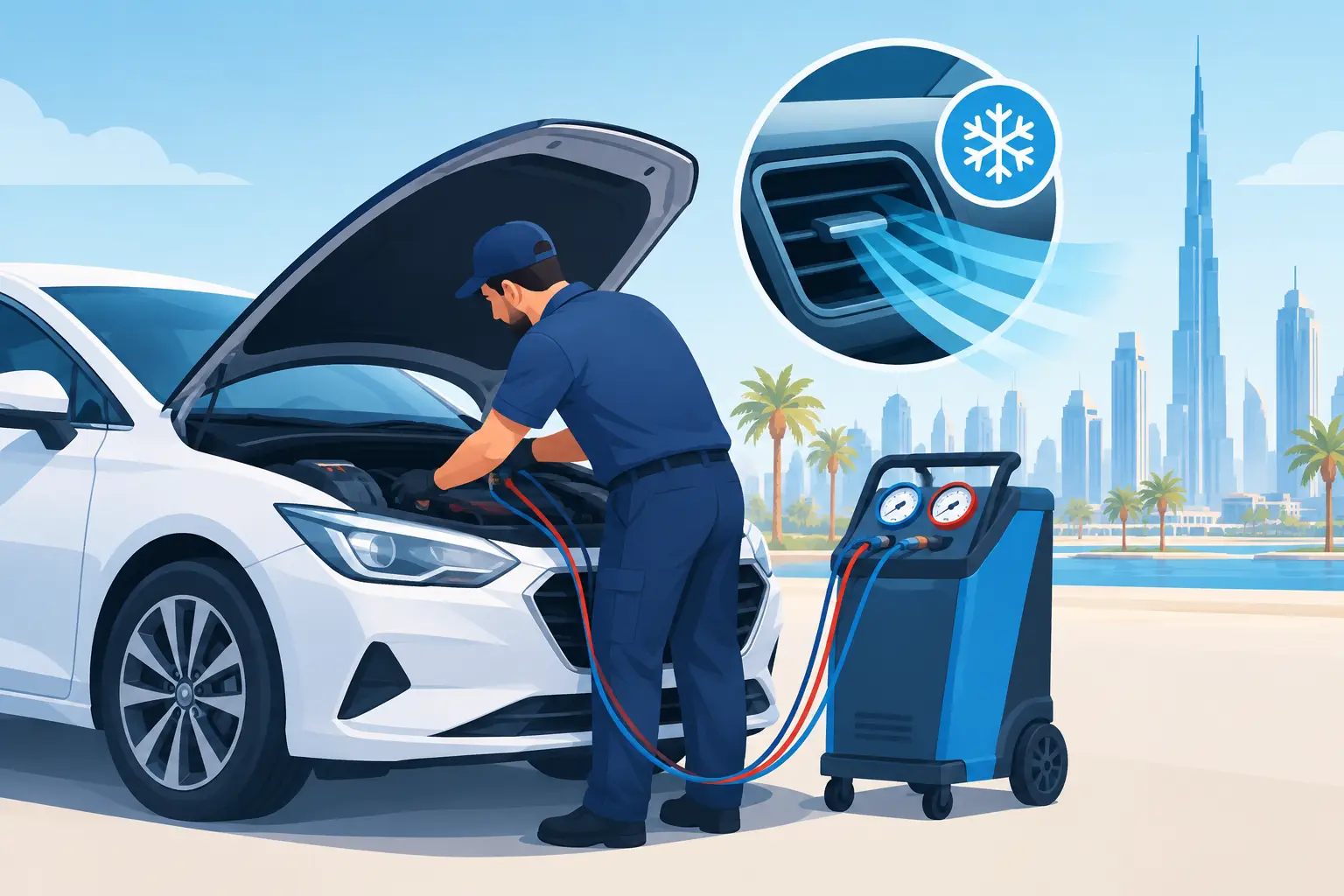
A Dubai summer exposes every weakness in a vehicle air conditioning system. If the cabin takes too long to cool, the air feels weak at traffic lights, or there is a musty smell from the vents, waiting for a complete failure is rarely the smart option. Professional car ac maintenance dubai helps prevent a small refrigerant leak, dirty evaporator, or failing fan from becoming an expensive compressor repair.
For daily commuters, family SUVs, luxury sedans, and performance cars, cold air is not a comfort feature you can ignore for long. It affects driver focus, passenger comfort, visibility when humidity fogs the glass, and the overall usability of the vehicle. The right maintenance plan finds the cause early and protects the components that work hardest in extreme heat.
Why Car AC Maintenance in Dubai Cannot Be Delayed
Dubai’s heat places continuous pressure on the compressor, condenser, cooling fans, hoses, seals, cabin filter, and electrical controls. In mild climates, a slight drop in cooling may go unnoticed for weeks. Here, it becomes obvious during a short drive from Dubai Marina to Business Bay or while sitting in afternoon traffic on Sheikh Zayed Road.
Heat is only part of the problem. Dust and fine sand can block condenser fins, reduce airflow, and make the system work harder to release heat. A clogged cabin air filter restricts air entering the cabin, while moisture inside the system can lead to poor performance and corrosion. Regular checks deal with these conditions before they affect major parts.
Maintenance is also more cost-effective than reacting to a breakdown. Replacing a filter or repairing a minor leak is usually straightforward. Running an AC system with low refrigerant, however, can reduce compressor lubrication and may eventually damage one of the most expensive parts of the system.
What a Proper AC Maintenance Service Includes
A proper inspection is more than adding AC gas because the air is no longer cold. Refrigerant does not get used up like engine oil. If the level is low, there may be a leak that needs to be identified and repaired before a refill. Otherwise, the cold air may return briefly, then disappear again.
An AC-focused technician should begin by measuring vent temperature, checking system pressure, and inspecting how the compressor engages. The condenser, hoses, seals, service ports, cooling fans, blower motor, and electrical connections should then be checked for obvious damage, leaks, or poor operation.
The evaporator and cabin filter also deserve attention. Dust, bacteria, and moisture can create unpleasant odors and reduce airflow. Evaporator cleaning and a fresh filter improve air quality inside the car and help the blower deliver air at its intended volume. If the blower is noisy, slow, or works only at certain speeds, the motor, resistor, and control circuit require diagnosis rather than guesswork.
For modern vehicles, technicians should use proper diagnostic equipment to inspect pressure sensors, temperature sensors, climate-control modules, actuators, and fault codes. This matters especially for Mercedes-Benz, BMW, Audi, Porsche, Range Rover, Jaguar, Lexus, Cadillac, and other premium vehicles with complex automatic climate systems.
Warning Signs That Need an AC Inspection
A change in cooling performance is the most common sign, but it is not the only one. Warm air from one side of the dashboard while the other side remains cold can point to a blend door, actuator, sensor, or refrigerant distribution issue. Weak airflow may be caused by a blocked filter, dirty evaporator, or failing blower motor.
Listen for clicking, squealing, rattling, or grinding when the AC is switched on. These noises can come from the compressor clutch, bearings, blower assembly, fan motor, or loose components. A burning smell, a persistent musty odor, or water leaking into the passenger footwell should also be checked promptly.
Pay attention to when the problem occurs. Cooling that is acceptable while driving but poor when stopped often suggests weak condenser airflow, a cooling fan problem, or a condenser blocked with debris. Cooling that fails after 20 to 30 minutes may involve pressure issues, a freezing evaporator, or an electrical fault. These details help a specialist diagnose the system faster.
How Often Should You Service Your Car AC?
For most Dubai vehicles, an AC health check once a year is a sensible minimum, preferably before the hottest months. A vehicle used heavily for school runs, ride-hailing, long commutes, or frequent stop-and-go driving may benefit from an inspection every six months. The same applies to older cars and vehicles that have already had an AC repair.
Cabin filters often need replacement more frequently than owners expect because of dust exposure. The exact interval depends on the vehicle, driving area, and filter condition, but inspection at every routine service is a practical approach. If airflow drops or odors appear, do not wait for the scheduled interval.
There is no fixed timetable for refrigerant refills. A sealed system should not require repeated top-ups. If a technician recommends a recharge, ask whether leak detection has been performed and whether the pressure readings support the repair. Transparent answers protect you from paying twice for the same issue.
Brand-Specific Care Makes a Difference
A Toyota, Nissan, Jeep, Ford, GMC, or Chevrolet may have a different AC layout and common failure pattern than a BMW, Mini Cooper, Volkswagen, Maserati, Bentley, Ferrari, or Rolls-Royce. The basic cooling cycle is similar, but component access, electronics, refrigerant specifications, oil requirements, and calibration procedures can vary significantly.
Luxury and exotic vehicles should not receive generic treatment. Incorrect refrigerant quantity, unsuitable compressor oil, poor-quality seals, or improper handling of sensitive trim can create avoidable problems. Genuine OEM parts or high-grade aftermarket alternatives, fitted by technicians familiar with the vehicle, offer better long-term reliability than a quick temporary fix.
The best repair choice also depends on the fault. A damaged condenser may need replacement, while a lightly blocked condenser may only need careful cleaning. A compressor that is noisy or producing metal debris often requires a wider system cleanup, not just a replacement part. Proper diagnosis prevents replacing components that are not actually at fault.
A Practical Maintenance Plan Between Workshop Visits
Owners can help their AC system perform better without attempting repairs at home. Run the AC periodically throughout the year, including cooler months, to help circulate lubricant through the system seals. Keep the area in front of the condenser clear of obvious debris, and replace the cabin filter when airflow declines or the service interval is due.
When getting into a car that has been parked in direct sun, open the doors or windows briefly to release trapped heat before demanding maximum cooling. Then use recirculation once the cabin starts cooling. This reduces the heat load on the system and helps it reach a comfortable temperature faster.
Avoid using pressure washers directly on condenser fins or adding refrigerant from an unverified can. Both can create more damage than savings. AC pressure, refrigerant charge, and leak repair need calibrated equipment and a technician who understands the system.
Get the Issue Fixed Before the Heat Peaks
Whether you drive in Al Barsha, JVC, Downtown, Palm Jumeirah, Mirdif, Arabian Ranches, JLT, or Dubai Marina, weak AC should be checked before it turns into a no-cooling emergency. Car AC Repair in Dubai provides focused inspections, leak detection, evaporator cleaning, compressor repairs, gas refills, fan and blower repairs, and brand-specific AC service backed by clear recommendations.
A fast inspection can reveal whether your vehicle needs simple maintenance or a more involved repair. Book the service while the AC is still working intermittently, and you are more likely to protect the system, control repair costs, and keep every drive comfortably cool.