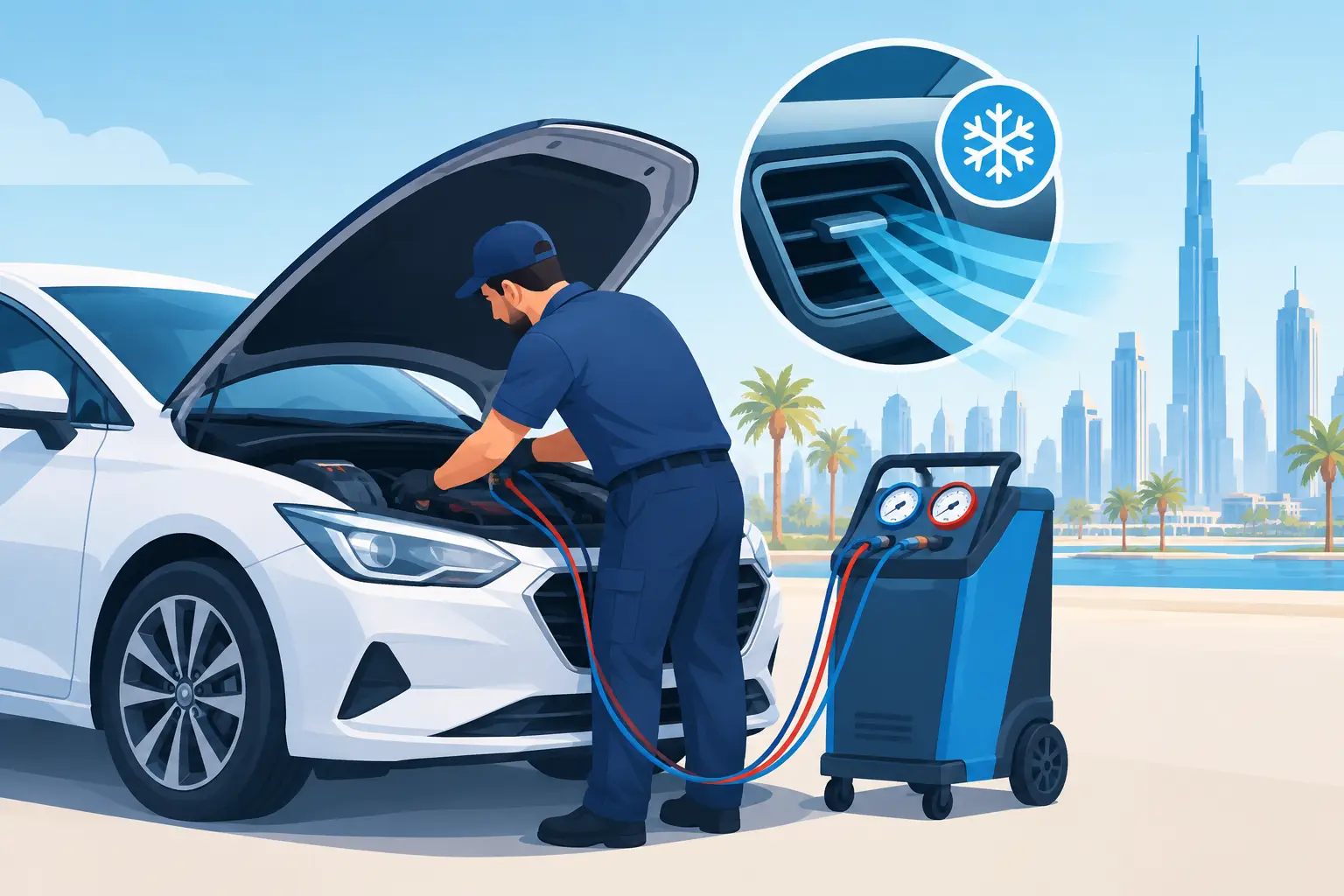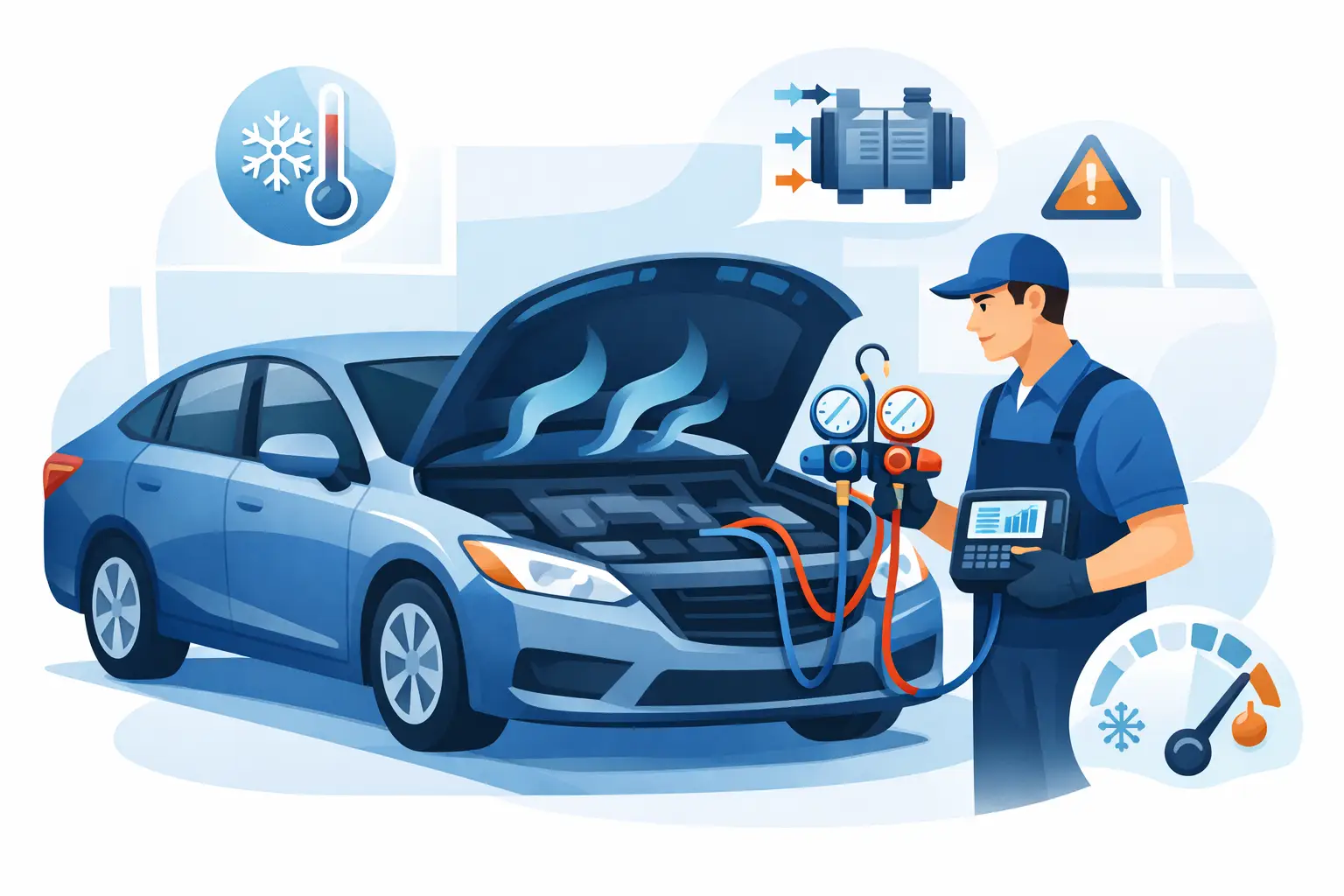
You usually notice the problem at the worst possible moment – midday traffic in Dubai, cold air fading, cabin heat rising, and the AC fan suddenly sounding louder than it should. Diagnosing car AC issues early matters because small faults in an air conditioning system rarely stay small for long. What starts as weak airflow or slightly warm air can quickly turn into compressor damage, refrigerant loss, electrical faults, or a full system shutdown.
For drivers in Dubai, AC trouble is not a minor comfort issue. It affects daily usability, visibility, cabin air quality, and the overall strain on your vehicle in extreme temperatures. That is why proper diagnosis matters more than guesswork, quick gas top-ups, or temporary fixes that do not address the real fault.
Diagnosing car AC issues starts with symptoms
A good diagnosis does not begin with replacing parts. It begins with what the system is doing, what it is not doing, and when the problem appears. If the AC blows warm at idle but cools while driving, that points in a different direction than an AC system that never gets cold at all. If airflow is weak from the vents, the cause may be very different from a system with strong airflow but no cooling.
This is where many general garages get it wrong. They may treat every complaint as a refrigerant problem, when the actual fault could be the compressor clutch, condenser efficiency, an expansion valve issue, a blocked cabin filter, a failing blower motor, or a sensor-related control fault. On modern BMW, Mercedes, Audi, Porsche, Range Rover, Lexus, GMC, Jeep, and exotic platforms, the AC system is tied closely to electronics, pressure regulation, and model-specific components. You need diagnosis that matches the vehicle, not a one-size-fits-all assumption.
The most common causes behind poor AC performance
Low refrigerant is common, but it is not the full story. Refrigerant does not simply disappear in a healthy sealed system. If the gas level is low, there is usually a leak somewhere in the lines, condenser, evaporator, compressor seals, or service ports. Refilling without finding the leak often gives you short-term cooling and a repeat failure soon after.
A weak compressor is another frequent issue, especially in vehicles exposed to heavy daily use and long idle times in traffic. The compressor may engage inconsistently, make noise, or fail to build proper pressure. In some cases, the clutch is the problem. In others, internal compressor wear has already started sending debris through the system, which changes the repair approach completely.
The condenser also takes a beating in Dubai. It sits in a vulnerable front position, exposed to heat, sand, road debris, and reduced airflow from blocked fins. A dirty or damaged condenser cannot release heat properly, which leaves you with poor cooling, especially at low speeds.
Then there are airflow issues. If your AC is cold but barely reaching the cabin, the fault may be a clogged cabin filter, blower motor problem, damaged fan resistor, or an issue with air blend doors inside the HVAC housing. Drivers often describe this as bad AC, but technically the cooling side may still be working. The delivery side is what is failing.
How specialists approach diagnosing car AC issues
Proper AC diagnosis is a step-by-step process. First comes performance testing. Vent temperature, ambient temperature, compressor operation, airflow strength, and system cycling behavior all provide clues. Then comes pressure testing, which shows whether the high and low side readings match expected values. Those readings help identify undercharge, overcharge, restriction, compressor weakness, or condenser inefficiency.
Leak detection is equally important. A professional workshop will not rely on guesswork when a system is low on refrigerant. UV dye, nitrogen pressure testing, electronic leak detectors, and visual inspection are used to pinpoint where the refrigerant is escaping. That matters because the repair for a leaking condenser is different from the repair for an evaporator leak hidden behind the dashboard.
Electrical testing is another part of the job, especially in newer vehicles. If the compressor is not engaging, the fault may not be mechanical at all. It could be a pressure switch, relay, fuse, temperature sensor, control module, or wiring problem. On premium and luxury vehicles, these systems can be more sensitive and more complex, which is exactly why brand-specific experience makes a difference.
Signs your car needs immediate AC inspection
Some symptoms mean you should not wait. If you hear grinding, squealing, or rattling when the AC is on, the compressor or pulley may be in trouble. If you notice a burning smell, repeated fuse issues, or the AC cutting in and out randomly, electrical faults may be developing. If there is water leaking unusually into the cabin, or a musty smell that does not go away, the evaporator area or drainage system may need attention.
Weak cooling during the hottest part of the day is also worth taking seriously. In Dubai, a system that feels acceptable in the morning can completely fail under peak heat load. That usually means the AC is already underperforming. It may still work in mild conditions, but it does not have enough efficiency left for real summer demand.
Why quick fixes often cost more later
Many drivers are offered a simple gas refill and sent back on the road. Sometimes that does restore cooling for a short period. But if the refrigerant was low because of a leak, the root cause remains. If the compressor is running with low refrigerant or low oil circulation, it can wear faster and eventually fail. At that point, repair costs rise because the job may require compressor replacement, flushing, expansion valve service, and further component checks.
The same applies to neglected filters, dirty evaporators, and failing blower motors. What begins as a minor airflow issue can put more strain on the rest of the system. Proper diagnosis saves money because it prevents unnecessary part replacement and catches faults before they spread.
Dubai conditions change the way AC systems fail
Not every AC issue happens the same way in every city. Dubai’s climate puts more pressure on condensers, compressors, cooling fans, seals, and refrigerant stability. Long idling, heavy traffic, dust exposure, and constant high cabin cooling demand all accelerate wear. That is why local experience matters when diagnosing car AC issues.
A workshop that handles AC systems every day in Dubai understands common failure patterns across German vehicles, American SUVs, Japanese sedans, and high-performance cars. A Porsche or BMW may have different control logic than a Tahoe or Jeep, and a Range Rover or Bentley may require a more precise diagnostic route than a standard passenger car. The system still follows AC principles, but the way faults present can vary by brand and model.
What a proper repair plan should include
Once the issue is identified, the repair should be clear and specific. You should know what failed, why it failed, what parts are required, and whether OEM or high-grade aftermarket options are being used. You should also know if the system needs leak repair, component replacement, evaporator cleaning, condenser service, gas refill to correct specification, or electrical work.
Transparent pricing matters here. So does testing after the repair. A quality AC repair is not finished when the part is installed. The system should be vacuum tested, recharged accurately, checked for leaks, and performance tested under load. That final stage is what confirms the problem is actually solved.
At a specialist workshop like Car AC Repair in Dubai, that focus on diagnosis first is what prevents repeat visits and half-fixed systems. For drivers in Dubai Marina, Jumeirah, Business Bay, Al Barsha, Downtown, JVC, Arabian Ranches, Mirdif, and surrounding areas, speed matters – but accuracy matters more.
If your AC has started acting differently, trust the change. Air conditioning systems usually give warnings before they fail completely. Catching the fault early gives you more repair options, lower risk of major component damage, and a much better chance of getting back to strong, reliable cooling without unnecessary expense.