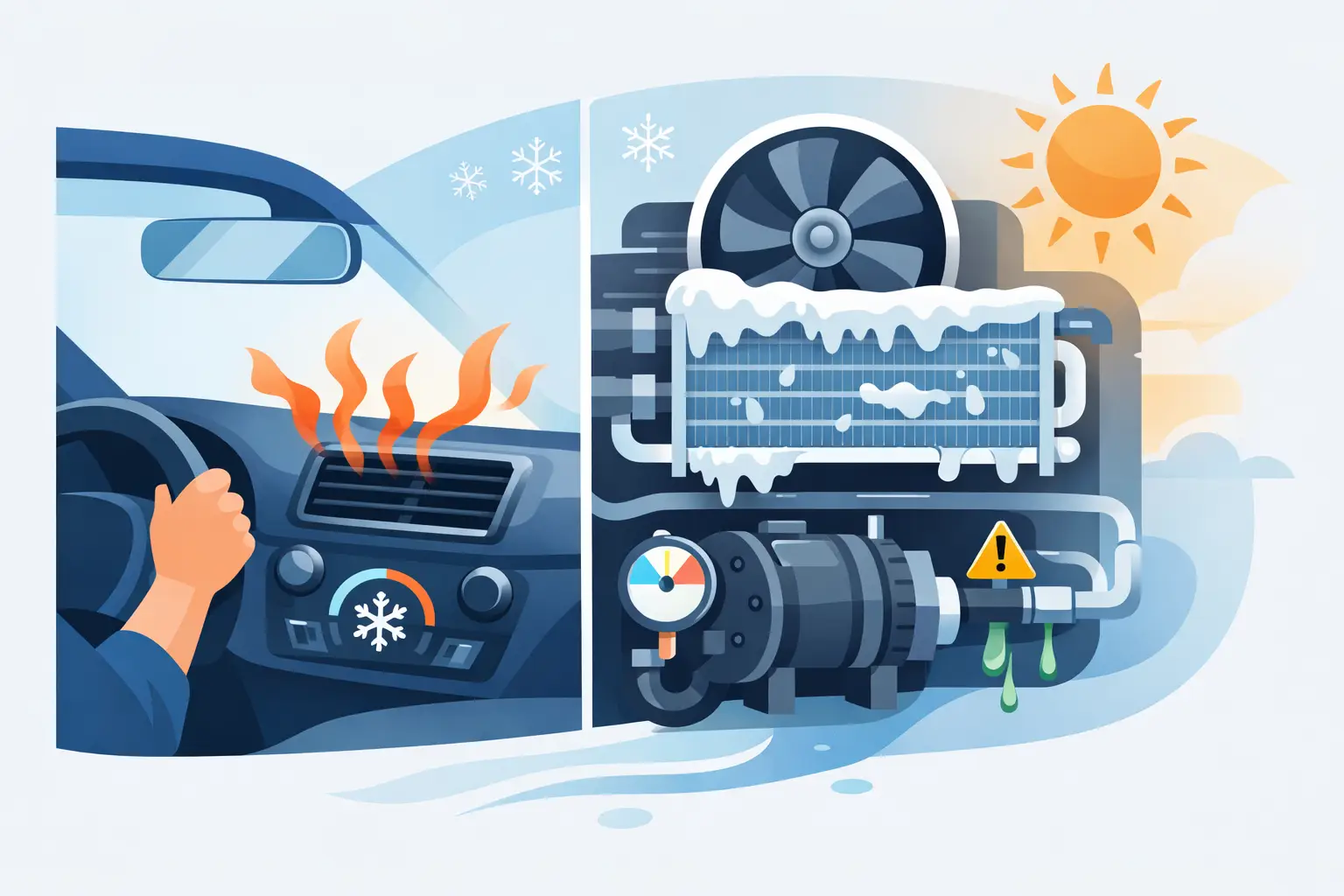
You usually notice possible car AC problems at the worst time – parked in Dubai traffic, driving home in peak afternoon heat, or starting the school run and getting warm air instead of cold. In this climate, a weak AC system is not a small inconvenience. It affects comfort, focus, and in many vehicles, overall cabin airflow and defogging performance too.
The challenge is that car AC issues rarely start with a full failure. Most systems show smaller warning signs first. The air may feel less cold than usual, cooling may take longer, the blower may become noisy, or the temperature may change without warning. Catching those signs early often means a simpler repair, lower cost, and less risk of damage to expensive components like the compressor.
Common possible car AC problems and what they mean
If your AC is blowing warm or only mildly cool air, low refrigerant is one of the most common causes. But low gas is usually a symptom, not the root problem. Refrigerant does not just disappear in a sealed system. If the level has dropped, there is often a leak in the condenser, evaporator, hose, seal, or compressor area. A quick refill may restore cooling for a short time, but if the leak is not found properly, the problem comes back.
Weak airflow is a different issue. In many cases, the system is producing cold air, but that air is not moving strongly through the vents. A clogged cabin filter, worn blower motor, faulty resistor, blocked evaporator, or fan issue can all reduce airflow. Drivers sometimes assume the AC gas is low when the real problem is in the ventilation side of the system.
Strange smells are another warning sign people ignore for too long. A musty odor usually points to mold, bacteria, or moisture buildup around the evaporator or inside the ducting. A burning smell may suggest an electrical issue, blower motor problem, or overheating component. Smell matters because it helps narrow the fault. Not every bad odor means the same repair.
Then there is inconsistent cooling. If the AC works well for ten minutes and then turns warm, or cools at highway speed but struggles in traffic, the diagnosis becomes more specific. That can indicate compressor wear, condenser efficiency issues, cooling fan faults, sensor problems, or pressure imbalances. In Dubai, stop-and-go driving exposes these weaknesses quickly because the system works harder when airflow across the condenser is limited.
Why possible car AC problems get worse in Dubai
Dubai is hard on air conditioning systems. Extreme heat increases system pressure, puts more strain on the compressor, and exposes even small weaknesses in hoses, seals, and electrical parts. A car that feels acceptable in mild weather may fail badly in summer.
This is also why brand-specific diagnosis matters. German luxury cars, American SUVs, Japanese sedans, and exotic performance vehicles do not all use the same AC layout or control logic. Some rely heavily on sensors and electronic modules. Others have common failure points in compressors, blend doors, expansion valves, or evaporators. A general workshop may identify the symptom. A dedicated AC specialist is more likely to find the cause without guesswork.
That difference matters even more with premium vehicles such as BMW, Mercedes, Audi, Porsche, Range Rover, Jaguar, Cadillac, Bentley, or Ferrari. Replacing parts without proper testing is expensive. Accurate diagnosis protects both the vehicle and the owner’s budget.
The most frequent component failures
The compressor is the heart of the AC system, and when it starts failing, cooling performance drops fast. Sometimes the clutch does not engage. Sometimes the internal mechanism wears out and cannot maintain pressure properly. In early stages, you may hear rattling, clicking, or grinding. In advanced cases, the system may stop cooling completely. Compressor problems should be handled carefully because debris from internal failure can contaminate the wider system.
The condenser is another frequent trouble point, especially in cities where road debris, dust, and heat are constant factors. A damaged or blocked condenser cannot release heat effectively, so the AC loses cooling power. This often shows up as poor performance when the vehicle is stationary.
Evaporator issues are more difficult because the part is buried deep in the dashboard area on many vehicles. Leaks here often cause weak cooling over time and may be accompanied by odor or moisture-related symptoms. Because access is labor-intensive, proper leak testing is essential before any major disassembly.
Electrical faults are increasingly common in newer vehicles. A blown fuse is the simple version. More complex failures involve pressure sensors, temperature sensors, control panels, wiring faults, relays, fan modules, and blend door actuators. When the AC behaves unpredictably, electronics are often part of the story.
Symptoms that need fast attention
Some issues can wait a day or two. Others should be checked immediately. If the compressor is making loud noise, if the AC cuts in and out, if airflow suddenly drops, or if you notice water leakage inside the cabin, delaying inspection can lead to more damage. The same applies if the engine temperature starts running higher than usual when the AC is on, since cooling fan issues can affect both engine cooling and AC performance.
A complete loss of cooling is obvious, but partial cooling is where many drivers lose time and money. When the air is cool only on one side, cold at speed but warm at idle, or strong from some vents and weak from others, there is already a fault developing. These are not normal variations. They are early warnings.
How proper diagnosis should be done
A professional AC check should go beyond adding gas and sending the car out. The right process includes pressure testing, leak detection, compressor performance checks, condenser and evaporator inspection, blower and fan testing, cabin filter review, and electrical diagnosis where needed. On modern cars, scan tools also help identify sensor and module faults that affect cooling behavior.
This is where many vehicle owners get frustrated. They have already visited a general garage, paid for a refill, and had the same issue return within days or weeks. That usually means the workshop treated the symptom only. A proper repair starts with finding the exact failure point.
At a specialist workshop such as Car AC Repair in Dubai, that focused approach is the standard expectation, especially for vehicles that need OEM-grade parts, accurate refrigerant charging, and clean repair procedures. That matters whether you drive a Toyota in Al Barsha, a Jeep in JVC, a Mercedes in Business Bay, or a Range Rover in Palm Jumeirah.
Repair or replace? It depends on the fault
Not every failed AC part needs full replacement. Some compressors can be repaired depending on the internal damage, model, and contamination level. Some blower issues are solved with a resistor or motor replacement rather than major system work. A clogged evaporator may need cleaning, while a leaking evaporator may require replacement.
The right choice depends on age, condition, vehicle type, and whether the fix will last. For a luxury or exotic vehicle, low-quality aftermarket parts often create repeat problems. For an older daily driver, a cost-effective high-grade replacement may be the smart move. Good advice should be based on long-term value, not just the cheapest immediate option.
How to reduce the risk of future AC problems
Regular AC servicing helps more than most drivers realize. It keeps the refrigerant level correct, catches leaks early, improves airflow, reduces odor, and prevents minor wear from becoming major failure. Cabin filter replacement also matters because blocked filters strain the blower and restrict cooling.
It also helps to run the AC regularly, even in cooler months, so seals stay lubricated and system components keep working normally. If cooling feels slightly weaker than usual, get it checked early. In Dubai, small AC problems do not stay small for long.
Drivers in Dubai Marina, JLT, Mirdif, Motor City, Downtown, Arabian Ranches, Silicon Oasis, and surrounding areas usually need speed as much as technical accuracy. That is why specialist diagnosis, transparent pricing, and warranty-backed repairs make a real difference. You want the issue solved once, not patched temporarily.
If your cabin is taking too long to cool, the vents smell wrong, the airflow feels weak, or the temperature keeps changing, trust what the car is telling you. Fast attention now is usually easier than a bigger AC repair later – and a properly cold cabin is not a luxury in Dubai, it is part of a car that is working the way it should.